That Cracked Sidewalk in Front of Your House Could Cost You More Than You Think
Most Idaho homeowners don’t think twice about the concrete panel heaving up near their front walkway or the section of sidewalk that’s lifted two inches above the next slab. It’s been there for years. The mail carrier navigates around it. The neighbors know to watch their step. It’s just… a thing.
Until someone doesn’t watch their step. Then it becomes a lawsuit.
Sidewalk trip hazard liability is one of those topics that flies completely under the radar until it’s too late. In Idaho, the rules around who’s responsible for a dangerous sidewalk — and what that responsibility actually means for your wallet — are specific enough that a lot of homeowners are unknowingly exposed. This isn’t a scare piece. It’s a practical breakdown of exactly where you stand under Idaho law and what you can do about it before a stumble becomes a six-figure problem.
Idaho’s “Premises Liability” Law and What It Means for Your Walkway
Idaho follows premises liability law, which means property owners have a legal duty to maintain reasonably safe conditions for people who enter their property — or in many cases, who pass alongside it. The key statute here is Idaho Code § 6-1401 through § 6-1406, which outlines the duty of care owed to different categories of visitors.
In plain terms: if someone is hurt because of a dangerous condition on or immediately adjacent to your property, and you knew about it (or reasonably should have known), you can be held liable for their injuries.
Now here’s where it gets interesting for sidewalks specifically. Idaho municipalities typically own the public sidewalk right-of-way, but that doesn’t automatically get homeowners off the hook. Many Idaho cities — including Idaho Falls — have local ordinances that place maintenance responsibility on the adjacent property owner. The city owns it in name, but you’re expected to keep it safe.
That distinction matters enormously in a liability claim.
What Idaho Falls Ordinances Actually Say About Sidewalk Maintenance
Idaho Falls municipal code requires property owners to maintain the sidewalks abutting their property in a condition that is safe for public use. This includes keeping them clear of snow and ice (within a reasonable window after a storm), but it also extends to structural conditions — cracks, heaving, and settlement that create trip hazards.
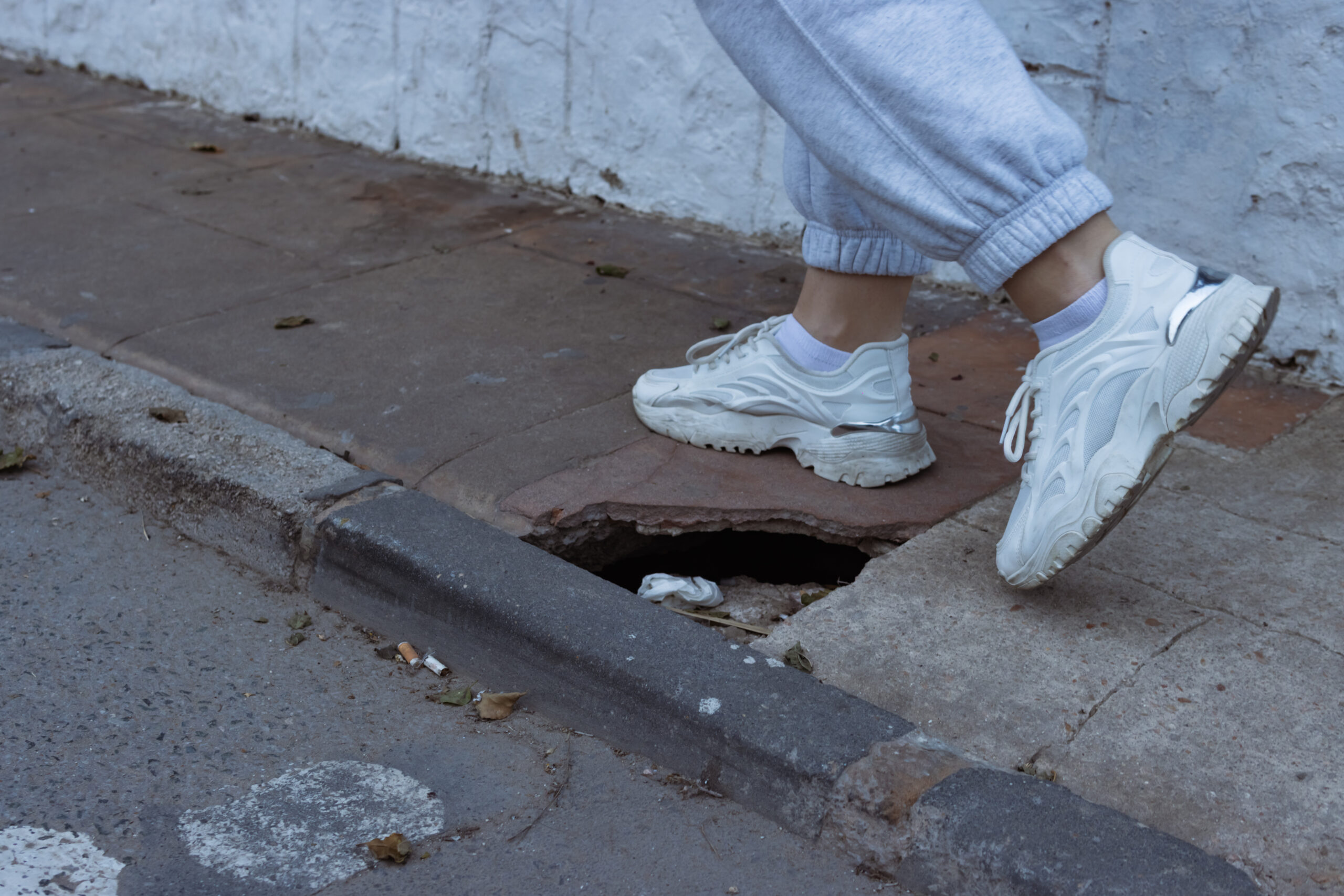
The threshold that courts and insurance adjusters typically use is a vertical displacement of half an inch or more. If one concrete panel has risen or dropped more than a half inch relative to the adjacent panel, that’s generally considered an actionable trip hazard. Some jurisdictions use a quarter inch. Eastern Idaho’s freeze-thaw cycles — which we’ve covered in depth when discussing concrete lifting in Idaho Falls — make this kind of heaving extremely common. What starts as a hairline crack in October can be a two-inch ledge by April.
The practical upshot: if there’s a measurable lip or raised edge on the sidewalk in front of your home, and someone trips on it, the legal argument that you bear some responsibility is not a stretch. It’s actually fairly straightforward.
The “Open and Obvious” Defense — and Why It Doesn’t Always Work
A lot of homeowners assume that if a hazard is visible, they can’t be held liable. “Anyone could see that crack,” the thinking goes. “They should have watched where they were going.”
Idaho courts recognize a doctrine called “open and obvious” as a potential defense. If a hazard is so apparent that any reasonable person would notice and avoid it, the property owner’s duty to warn or remedy may be reduced. But — and this is critical — this defense is far from bulletproof. Idaho follows comparative negligence under Idaho Code § 6-801, meaning fault can be apportioned between parties.
Here’s what that looks like in practice: A jury might find that you were 60% responsible for not fixing a known hazard, and the person who tripped was 40% responsible for not paying attention. Under Idaho’s comparative negligence rule, the injured party can still recover 60% of their damages from you. If their medical bills, lost wages, and pain and suffering total $150,000, you’re on the hook for $90,000.
The open and obvious defense also gets complicated at night, in bad weather, or when the person tripping has any kind of distraction that a reasonable person might have. Courts have been skeptical of property owners who rely on this defense for conditions that have existed for months or years.
“Knowing about a hazard and doing nothing about it is often the most damaging fact in a premises liability case. It transforms an accident into negligence.” — Common framing used by plaintiff’s attorneys in Idaho slip-and-fall cases
Who’s Actually Walking on Your Sidewalk (and Why It Matters)
Idaho premises liability law distinguishes between three categories of visitors, and the duty of care you owe depends on which category they fall into:
- Invitees — People you’ve invited onto your property, or who enter for a purpose for which the property is held open to the public. You owe them the highest duty of care.
- Licensees — Social guests, neighbors, people with implied permission to enter. You owe them a duty to warn of known dangers.
- Trespassers — People with no permission to be there. Generally, you only owe them a duty not to create willful or wanton hazards.
For a public-facing sidewalk, most people who use it will be treated as invitees or at minimum licensees. Mail carriers, delivery drivers, neighbors, strangers cutting through — they all have implied permission to use a public walkway. That puts them in the highest-protection category, and you in the highest-exposure category.
Your Homeowner’s Insurance: The Good News and the Fine Print
The good news: standard homeowner’s insurance policies in Idaho typically include personal liability coverage that can respond to premises liability claims, including sidewalk trip injuries. Most policies carry at least $100,000 in liability coverage, and many carry $300,000 or more.
The bad news: insurance companies aren’t obligated to pay claims for conditions you knew about and failed to address. If an adjuster or opposing attorney can show that you were aware of a dangerous sidewalk condition for an extended period and took no action, your insurer may argue that you failed your duty to maintain the property — which can complicate or reduce what they’re willing to cover. Some policies also have specific exclusions for “maintenance-related” damage.
The even worse news: medical costs, legal fees, and settlements in serious trip-and-fall cases can easily exceed your policy limits. According to data from slip-and-fall cases nationally, the average settlement for a trip-related injury involving a broken bone is in the range of $15,000–$45,000, but cases involving hip fractures (extremely common in older adults), head injuries, or surgeries can push well into six figures. If your policy has a $100,000 limit and a jury awards $180,000, that gap comes out of your personal assets.
How the Cost of Fixing It Compares to the Cost of Not Fixing It
This is where things get really concrete — no pun intended. We’ve put together a detailed breakdown of concrete lifting costs in Eastern Idaho in our post on how much concrete lifting costs in Eastern Idaho, but the short version is this: polyurethane foam lifting for a typical sidewalk panel runs somewhere in the range of a few hundred dollars per panel. Replacing that panel runs significantly more. Both numbers are a small fraction of what even a modest slip-and-fall settlement looks like.
When you frame sidewalk repair as risk management rather than home improvement, the math changes completely. You’re not spending $800 to fix a sidewalk. You’re spending $800 to eliminate a liability that could cost you $80,000. That’s a 100:1 return on investment before anything bad even happens.
And if you’re wondering whether uneven concrete is really that dangerous — it genuinely is. We break down the specific injury risks and statistics in our piece on whether uneven concrete is a safety hazard. The short version: the Consumer Product Safety Commission consistently ranks uneven walking surfaces among the top causes of fall-related injuries, and falls are the leading cause of injury-related emergency room visits in the U.S.
Documentation: Your Best Friend If Something Does Happen
Even if you’re actively working to fix a hazard, things happen. Here’s how to protect yourself in the meantime:
- Take dated photos of any sidewalk conditions you’re aware of, along with records of when you noticed the issue
- Get a repair estimate in writing — having a dated quote from a contractor shows you were actively pursuing a fix, not ignoring the problem
- Install temporary warning — orange cones, caution tape, or even a simple spray-painted warning on the concrete can document that you flagged the hazard
- Check your municipality’s process — in some cases, you can formally notify your city of a sidewalk hazard and request repair. This creates a paper trail that can be useful if liability is disputed
- Review your homeowner’s policy — know your liability limits before something happens, not after
When to Call for a Professional Assessment
Not every crack is a crisis, and not every uneven panel requires emergency intervention. But some signs are worth acting on quickly. If you’re seeing any of these, get an assessment before someone else notices:
- Any vertical displacement between panels of half an inch or more
- A section of walkway that rocks or shifts when you step on it
- Cracks that have widened or shifted since you last looked at them
- Areas where water is pooling on or near the concrete (a sign of settlement underneath — something we explain in our post on what causes concrete to sink)
- Any concrete adjacent to tree roots that’s started to lift
The other thing to know: polyurethane foam lifting — the process we use at Solid Lifters — can typically correct most trip hazards in a matter of hours, with the concrete fully usable the same day. You don’t have to rip out slabs, wait for cure times, or deal with weeks of disrupted access. If you’re curious about the process and whether it applies to your situation, you can learn more about how polyurethane concrete lifting works or take a look at some examples of our completed work.
The Bottom Line on Idaho Sidewalk Liability
Here’s the honest summary: Idaho law doesn’t give homeowners a free pass on sidewalk conditions just because the city technically owns the right-of-way. If you know about a trip hazard in front of your home and do nothing, you carry meaningful legal exposure — and that exposure increases every day the hazard exists.
The freeze-thaw cycles that define Eastern Idaho winters are particularly aggressive at creating exactly this kind of problem, often turning minor cracks into serious ledges over the course of a single winter. By spring, what you thought was a cosmetic issue may have become a genuine liability. Catching it early — while it’s still a minor settlement that a foam injection can fix quickly — is almost always cheaper, faster, and less disruptive than waiting.
If you’re not sure whether your sidewalk clears the threshold, check out our guide on the signs your concrete needs lifting before things get worse, or reach out for a free assessment. A professional eye on the problem costs you nothing, and the peace of mind of knowing exactly where you stand is worth the conversation.
The sidewalk out front is easy to ignore. Just make sure you don’t ignore it until someone else forces you to pay attention.