Fill hollow spaces under your concrete with polyurethane foam before the slab cracks or sinks. Serving Jackson Hole, Teton Valley, Star Valley, and the Idaho Falls area.
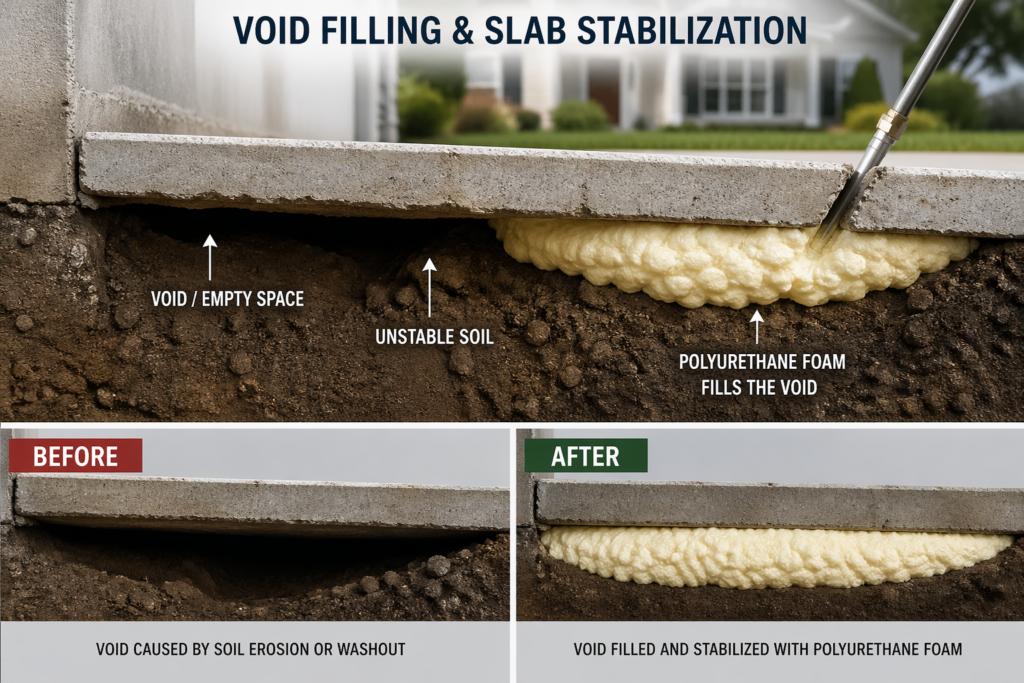
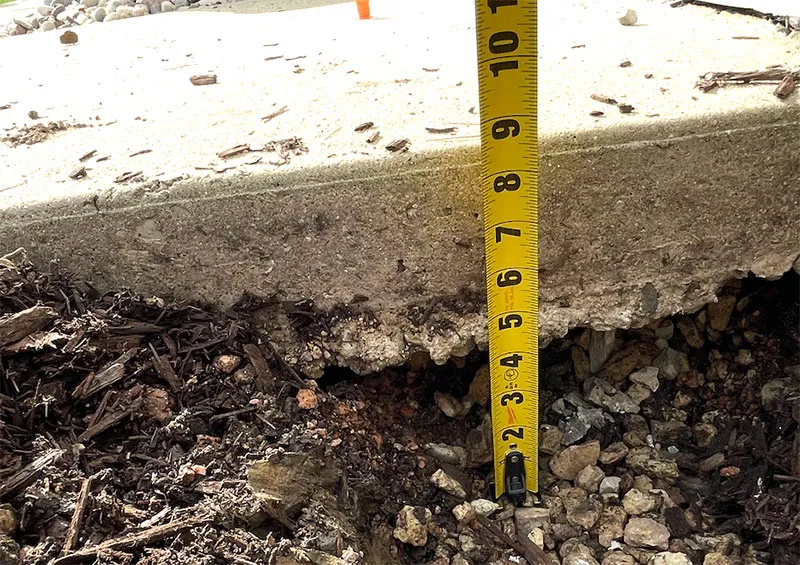
Water from snowmelt, downspouts, and runoff can wash soil out from under a slab and leave an empty space. The concrete above may still look fine, but it’s now bridging a hole. Eventually it cracks or drops.
Void filling puts the support back. We inject polyurethane foam through small holes; it expands to fill the void and hardens into a solid, waterproof base. If the slab has already sunk, we can lift it at the same time.
Concrete depends entirely on the ground beneath it. When that support weakens, problems begin to develop below the surface.
Our process focuses on restoring strong, reliable support beneath your concrete.
We assess the condition of the slab and identify areas where support is missing.
Small access points are created to reach beneath the concrete.
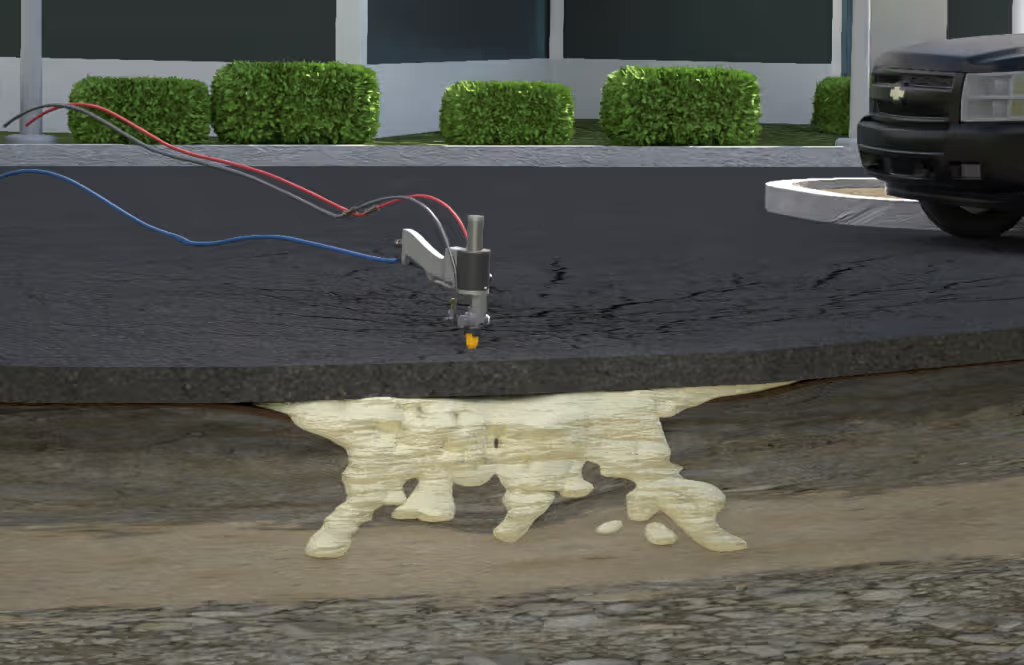
Polyurethane foam is injected below the slab where it expands to fill voids and reinforce the soil.
The material hardens into a durable base. The surface is sealed and ready for use quickly.
When the base beneath concrete is no longer stable, the slab above becomes vulnerable to movement and damage.
This often leads to:
Polyurethane foam flows into gaps of any shape, expands to fill them completely, and cures in minutes into a lightweight, waterproof base. It doesn’t add heavy weight to soft soil the way mudjacking slurry does, and it won’t erode when water runs under the slab again.
Void filling works anywhere concrete has lost support underneath, even before it starts to sink.
Common spots:
We fill voids under concrete in Jackson Hole (Jackson, Wilson, Teton Village, Hoback), Teton Valley (Driggs, Victor, Tetonia), Star Valley (Alpine, Etna, Thayne, Afton), Swan Valley, and the Idaho Falls area, including Ammon, Iona, Ucon, Shelley, Rigby, and Rexburg.
In many cases, the signs are not immediately visible. You may notice hollow sounds when tapping the surface, small cracks forming, or slight movement when weight is applied. Over time, this can lead to sinking or uneven areas. A professional inspection can confirm if voids or weak soil are present beneath the slab.
Yes, and it is often the best time to do it. Filling voids early helps prevent the slab from dropping or cracking later. Addressing the issue before visible damage appears can save you from more expensive repairs in the future.
Void filling is often part of the lifting process, but it can also be done as a standalone service. If your concrete is still level but has gaps underneath, stabilizing the base early can prevent the need for lifting later.
Polyurethane foam is designed to provide long term support. It is resistant to moisture and does not break down easily over time. When properly applied, it can maintain stability for many years.
Void filling and slab stabilization significantly reduce the risk of future sinking and cracking. While no solution can stop all ground movement, reinforcing the base beneath your concrete greatly improves its durability and performance.
Use the form below or call us directly to get started.
See what our customers are saying about our concrete lifting services, our process, and the results we deliver.


 Trustindex verifies that the original source of the review is Google.
 Trustindex verifies that the original source of the review is Google.
 Trustindex verifies that the original source of the review is Google.
 Trustindex verifies that the original source of the review is Google.
 Trustindex verifies that the original source of the review is Google.
 Trustindex verifies that the original source of the review is Google.

 Trustindex verifies that the original source of the review is Google.
 Trustindex verifies that the original source of the review is Google.
 Trustindex verifies that the original source of the review is Google.
 Trustindex verifies that the original source of the review is Google.
If you can see a gap under the edge of your concrete, or hear a hollow sound when you tap it, fill it now before it cracks. Text a photo to (208) 970-5585 for a quick ballpark, or request a free estimate.